Race Crazy by Charles Love
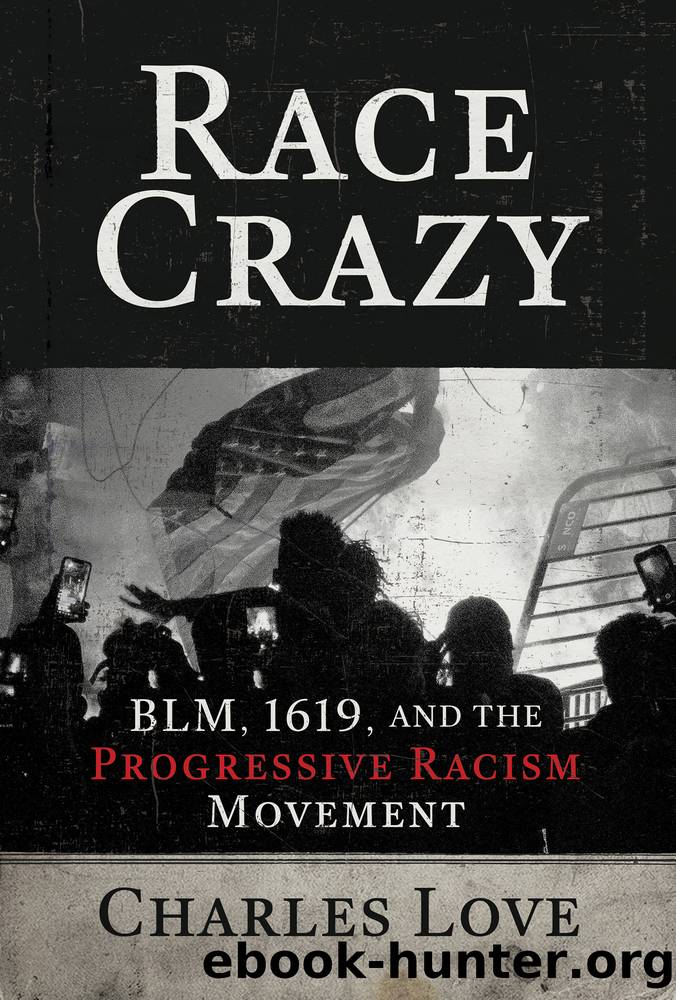
Author:Charles Love [Love, Charles]
Language: eng
Format: epub
ISBN: 9781642938425
Publisher: Post Hill Press
Published: 2021-09-02T00:00:00+00:00
12
The Idea of America
Our democracyâs founding ideals were false when they were written. Black Americans have fought to make them true.
âNikole Hannah-Jones
The first and most important essay of The 1619 Project was written by Nikole Hannah-Jones, a staff writer for the New York Times, and the founder of the Project. Where my previous chapter summarized the Project, as presented by the magazineâs editor, this chapter will serve as a detailed explanation of the genesis of the Project and its alleged importance to the fabric of America.
Hannah-Jonesâs essay, âAmerica Wasnât a Democracy Until Black Americans Made It One,â is about slaveryâs origins in America and its effects on black Americans today. It is well-written, detailed in some areas, vague in others. There are plenty of facts in her essay, and while the ugliness of slavery and racism are vividly detailed, she could have been even more graphic and presented a greater volume of examples if inclined. This cannot be disputed. What she is missing, though, and what the entire 1619 Project is lacking, is logic and context.
The shortsightedness of the Project has less to do with the quality of the research or the intellect of the presenters than it does with the emotionally clouded judgment applied to the information gathered. They were not seeking truth; they were seeking confirmation bias. A common tactic used in most of the essays is to start with a fact, but weave their opinions into it. This would not be a problem if they did not present their opinions as fact. One example is the case of Hiram Rhodes Revels.
Hiram Rhodes Revels was the first black American elected to the U.S. Senate. Prior to his mention, the essay states, ââ¦they [black voters] headed in droves to the polls, where they placed other formerly enslaved people into seats that their enslavers had once held.â This implies that black voters catapulted Revels to the Senate. What the essay fails to mention is that U.S. Senators were elected by state legislatures, and since Senator Revels was elected in February of 1870âweeks after Mississippi ratified the Fifteenth Amendment and a month before the Constitution was amendedâhis election was won with the votes of only whites.
This distortion of history is an example of why this Project is so dangerous. The essays are gripping; they tell compelling stories of the putrid hatred and violence many innocent blacks experienced at the hands of whites. They chronicle actions government officials took that hurt blacks, many of them intentional, and the long shadows they cast, as well as the overt racism of white citizens these legislators condoned or permitted. But the Project is woefully incomplete. It does not present any positives, only occasional examples of blacks overcoming obstacles. In their telling, few whites did anything right, and even they benefitted from slavery, so they were also bad.
This is intellectually lazy. It cheats the reader and anyone it is presented to as an educational tool. Many may not be aware that The 1619 Project is being
Download
This site does not store any files on its server. We only index and link to content provided by other sites. Please contact the content providers to delete copyright contents if any and email us, we'll remove relevant links or contents immediately.
Cecilia; Or, Memoirs of an Heiress — Volume 1 by Fanny Burney(32561)
The Great Music City by Andrea Baker(32021)
Cecilia; Or, Memoirs of an Heiress — Volume 2 by Fanny Burney(31958)
Cecilia; Or, Memoirs of an Heiress — Volume 3 by Fanny Burney(31944)
We're Going to Need More Wine by Gabrielle Union(19051)
All the Missing Girls by Megan Miranda(16042)
Pimp by Iceberg Slim(14517)
For the Love of Europe by Rick Steves(14151)
Bombshells: Glamour Girls of a Lifetime by Sullivan Steve(14079)
Talking to Strangers by Malcolm Gladwell(13375)
Norse Mythology by Gaiman Neil(13372)
Fifty Shades Freed by E L James(13245)
Mindhunter: Inside the FBI's Elite Serial Crime Unit by John E. Douglas & Mark Olshaker(9346)
Crazy Rich Asians by Kevin Kwan(9295)
The Lost Art of Listening by Michael P. Nichols(7507)
Enlightenment Now: The Case for Reason, Science, Humanism, and Progress by Steven Pinker(7315)
The Four Agreements by Don Miguel Ruiz(6767)
Bad Blood by John Carreyrou(6625)
Weapons of Math Destruction by Cathy O'Neil(6283)
